Building a Clear Discussion Sequence
Orchestrate hybrid team debates with structured turn-taking, intentional speaker pacing, and synchronized virtual queues.
Establishing Predictable Rhythm in Hybrid Dialogues
Hybrid conversations frequently collapse when in-room participants naturally bounce comments back and forth, leaving remote attendees stranded in digital silence. A structured discussion sequence replaces conversational free-for-alls with a transparent, sequential workflow that gives equal weight to both physical and remote contributors.
By anchoring every debate on predefined speaking windows and visual turn indicators, teams eliminate conversational collisions and reduce the cognitive burden on facilitators. The sequence transforms unstructured chatter into focused decision-making intervals where every perspective is captured before moving forward.
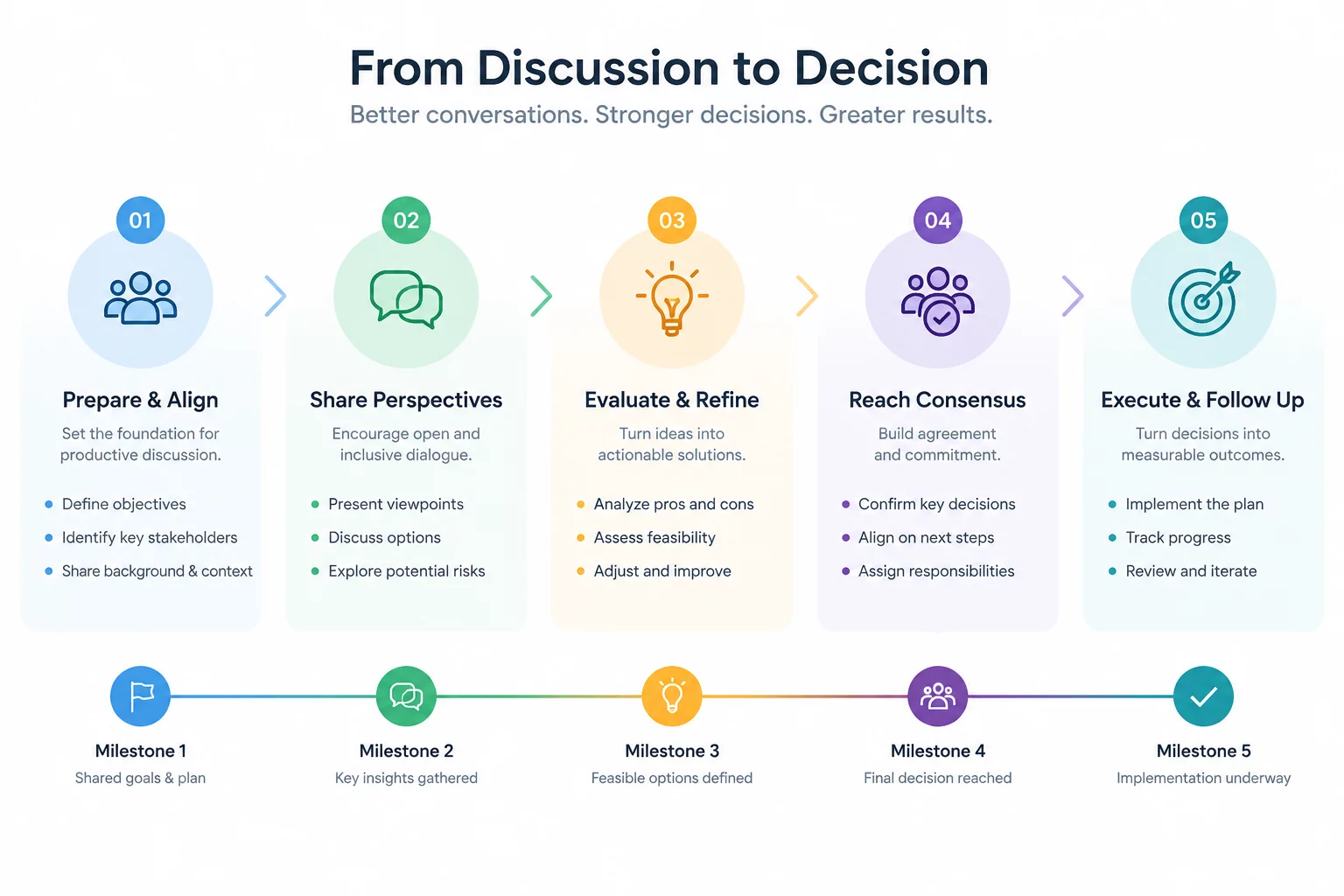
A project review ends with the room having decided everything and remote members unsure what was agreed. The scenario below shows how an explicit speaking order gives every participant a known turn.
How Participants Interact Across the Session
Sequence Protocol Architecture
Key technical and facilitator parameters configured to maintain order and conversational equity across distributed endpoints.
| Framework Dimension | Protocol Specification |
|---|---|
| Turn Sequencing Engine | Alternating round-robin (Physical ↔ Remote parity) |
| Floor Request Mechanism | Integrated digital hand-raise with centralized on-screen queue |
| Screen Layout Pacing | Active-speaker spotlight alongside persistent agenda sequence |
| Facilitator Role | Dedicated timekeeper and turn-transition conductor |
| Contribution Timebox | 90 seconds per initial remark, 45 seconds for counterpoints |
| Interruption Protocol | Strict mute-discipline with formal moderator handoff |
Implementing the Four-Phase Discussion Sequence
Implementing a predictable discussion cadence requires deliberate staging. Rather than opening the floor immediately to general comments, the facilitator leads the assembly through distinct micro-phases designed to collect observations, synthesize diverging views, and formulate a unified agreement.
Step-by-Step Sequence Execution
- Context Framing (3 Mins): The facilitator outlines the specific decision criteria and posts the core question to the shared digital whiteboard.
- Silent Formulation (2 Mins): In-room and remote team members log bullet thoughts in shared notes before any spoken dialogue begins.
- Sequential Input Round: Speakers are called strictly in alternating order between room seats and remote queue entries without crosstalk.
- Consensus Synthesis: The moderator reads out converged viewpoints and logs open action items before confirming the next topic.
This predictable sequencing prevents dominant personalities from hijacking the meeting, provides introverted and remote colleagues with explicit entry points, and produces clearer action items in significantly less time.
Frequently Asked Questions
Practical solutions for handling edge cases and timing friction during sequential hybrid discussions.
Participants use the chat channel or quick digital reaction icons to indicate an immediate clarifying point. The facilitator allocates a brief 30-second clarification window before returning to the formal sequence queue.
While the initial round feels deliberate, it prevents prolonged side-conversations and circular debates, ultimately reducing total meeting duration by 20% to 35%.
The facilitator gently intervenes, reminds the room of the active speaker indicator, and redirects attention to the queued remote colleague. Visual queue monitors on the front room display reinforce this behavior.
Capture them in a visible parking lot with an owner or follow-up point, then return to the current discussion. This preserves the idea without breaking the sequence.
Have a designated recorder note the decision, any unresolved condition, the responsible owner, and the next action. Review the summary before the facilitator advances the group.
Related Methodologies