Shifting Workplace Dynamics and Attendance Realities
The 10th edition of the Owl Labs State of Hybrid Work Report highlights a defining shift from experimental hybrid setups toward consolidated infrastructure. While organizations increasingly formalize hybrid attendance policies, employee sentiment reveals that mandate compliance hinges entirely on the practical utility of physical office days.
Rather than showing up for routine solo tasks, distributed staff demand meaningful in-person collaboration spaces. When team members commute only to sit on video calls behind closed doors, engagement plummets. Organizations that redesign meeting architectures around equitable collaboration report significantly higher job satisfaction.
2026 Key Statistical Highlights
- Meeting Room Upgrades: 71% of surveyed IT leaders increased budgets for intelligent video bars and multi-camera systems to eliminate visual blind spots.
- Policy Rigidity Impact: Companies enforcing strict badge tracking saw a 31% surge in passive job hunting among mid-level engineering and product talent.
- Meeting Fatigue Factor: Unproductive hybrid meetings were ranked as the number one time-sink, consuming an average of 4.2 hours per employee weekly.
- Micro-Presence Equity: 58% of remote participants report feeling excluded when in-room conversations overlap without designated digital moderation.
Bridging the Audiovisual Divide in Hybrid Spaces
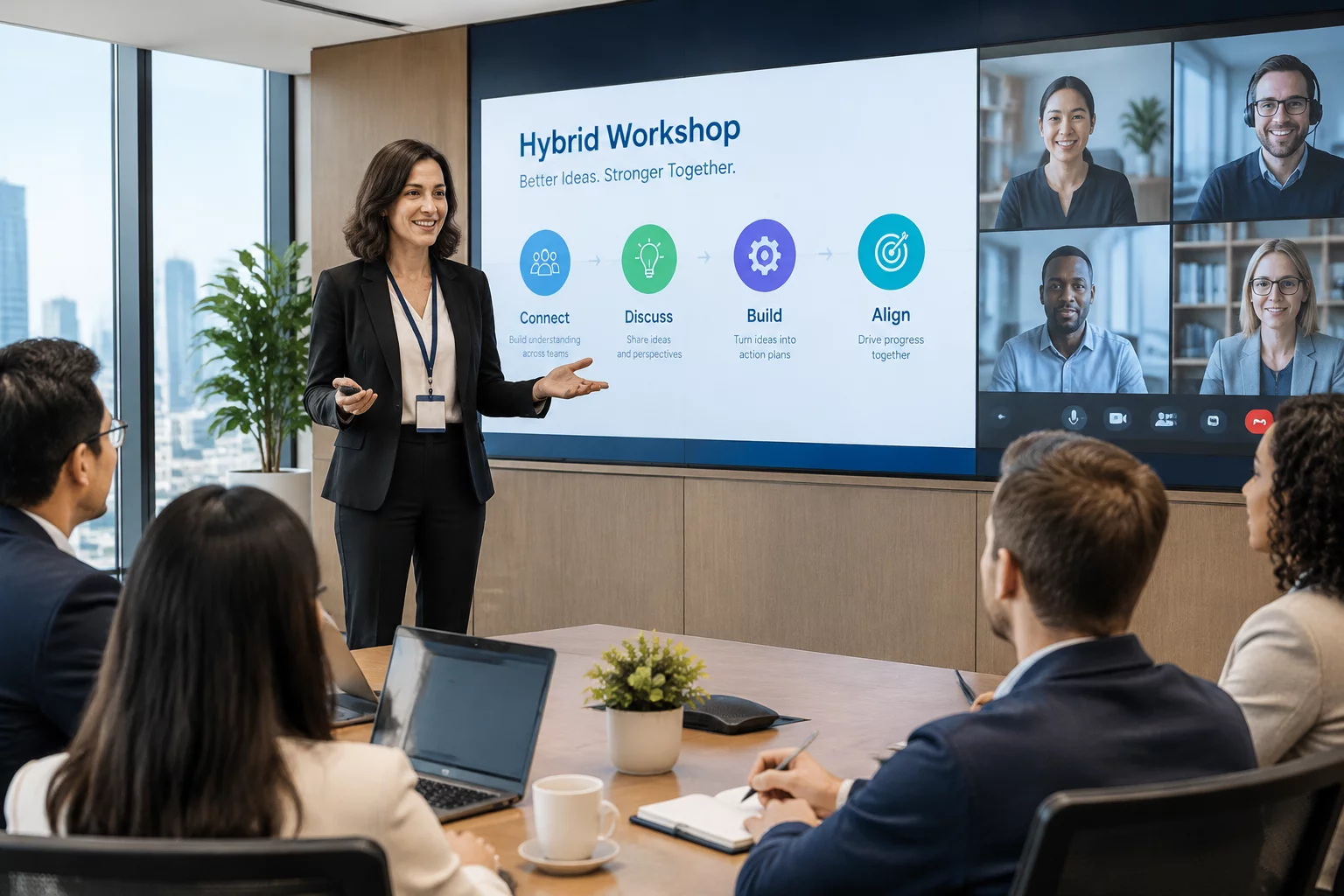
Meeting equity emerged as the most critical technological priority in the annual survey. Standard wide-angle room cameras often fail to convey subtle facial expressions or track spontaneous speaker changes, leaving dial-in attendees feeling like passive observers rather than active collaborators.
To counteract this imbalance, forward-thinking organizations are pairing intelligent framing hardware with formalized meeting facilitation protocols. Equalizing audio capture levels and ensuring equal visual presence directly correlates with shorter, more decisive team sessions.
True hybrid collaboration requires solving the meeting room divide. Equipping physical spaces with smart AV technology and structured conversational turn-taking is no longer optional—it is foundational to retention and execution.— Owl Labs State of Hybrid Work Research Group
Standardizing Hybrid Meeting Room Operations
Data from the report confirms that technology investments succeed only when paired with clear operational standards. The table below outlines how top-performing hybrid organizations synchronize physical room setups with remote participant expectations to maintain continuous workflow parity.
Operational Parity Framework for Hybrid Meeting Rooms
| Dimension | In-Room Standard | Remote Standard | Expected Outcome |
|---|---|---|---|
| Visual Presence | Individual framing with smart center-of-table multi-camera devices | High-definition webcam with centered eye-level framing | 100% individual facial clarity for all attendees |
| Voice Distribution | Beamforming ceiling and tabletop mic arrays with noise filtering | Dedicated boom or USB mic with acoustic echo suppression | Uniform sound levels and zero conversational clipping |
| Contribution Flow | In-room moderator tracking digital hands and whiteboard feeds | Digital chat integration and queue-based turn-taking | Equal speaker participation and eliminated proximity bias |
By standardizing these physical and digital configurations across all conference areas, organizations reported a 42% reduction in post-meeting alignment loops and a substantial decrease in remote employee detachment.