The Current Landscape of US Hybrid Employment
Gallup workplace studies demonstrate that hybrid work has matured from a transitional policy into the permanent operating standard for remote-capable US enterprises. Knowledge workers now balance focused asynchronous tasks at home with synchronous collaborative sessions at office facilities.
Organizations achieving the highest productivity metrics coordinate office days around meaningful team interactions rather than arbitrary badge-swipe requirements. When employees travel to corporate offices only to spend the day isolated on virtual calls, workplace satisfaction declines sharply and employee disengagement rates climb.
Key Statistical Indicators
- Hybrid Adoption Rate: More than 53% of remote-capable professionals maintain structured hybrid schedules.
- Peak Occupancy Days: Tuesday through Thursday capture over 70% of total weekly office attendance.
- Engagement Multiplier: Shared team-level scheduling agreements produce 3.4x higher net engagement.
- Retention Impact: Autonomous scheduling protocols reduce voluntary turnover intentions by 27%.
Navigating In-Office Purpose and Meeting Culture
A central challenge highlighted in Gallup findings is the disconnect between executive expectations and daily team realities. While management frequently cites informal serendipity as the primary goal of in-person attendance, employees express a strong preference for structured workshops, mentorship forums, and complex decision-making discussions.
Executing effective hybrid sessions requires conscious meeting facilitation. Without structured speaking sequences and audio normalization, meetings frequently favor in-room attendees while leaving remote colleagues disengaged from vital project deliberations.
Purposeful presence transforms the office from a mandatory attendance checkpoint into an intentional collaborative accelerator.— Gallup Workplace Dynamics Analysis
Operational Framework for Balanced Hybrid Sessions
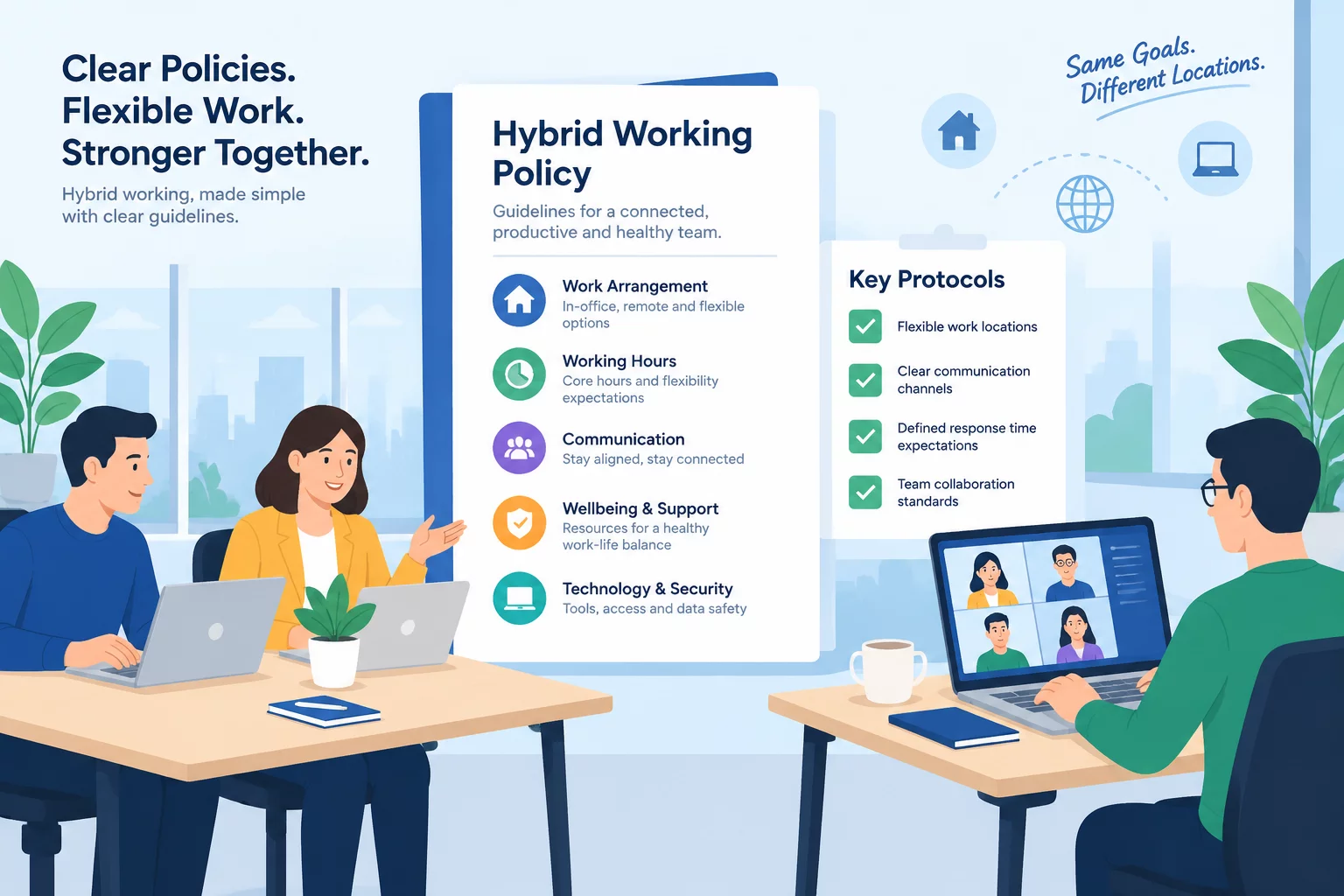
To eliminate presence disparity identified across surveyed enterprises, teams should adopt clear standards that balance physical presence with digital access throughout collaborative meetings.
Hybrid Collaboration Equity Matrix
| Dimension | In-Room Standard | Remote Standard | Expected Outcome |
|---|---|---|---|
| Airtime Parity | Digital hand-raising queue | Audio level normalization | Equal speaking opportunity |
| Visual Workspace | Interactive display screen | Digital canvas live sync | Unified artifact visibility |
| Action Capture | Shared live documentation | Asynchronous review thread | Zero ambiguity on next steps |
Implementing structured meeting methodologies ensures organizations protect team autonomy while extracting maximum value from both in-person and digital collaboration days.