The Operational Anchor of Hybrid Collaboration
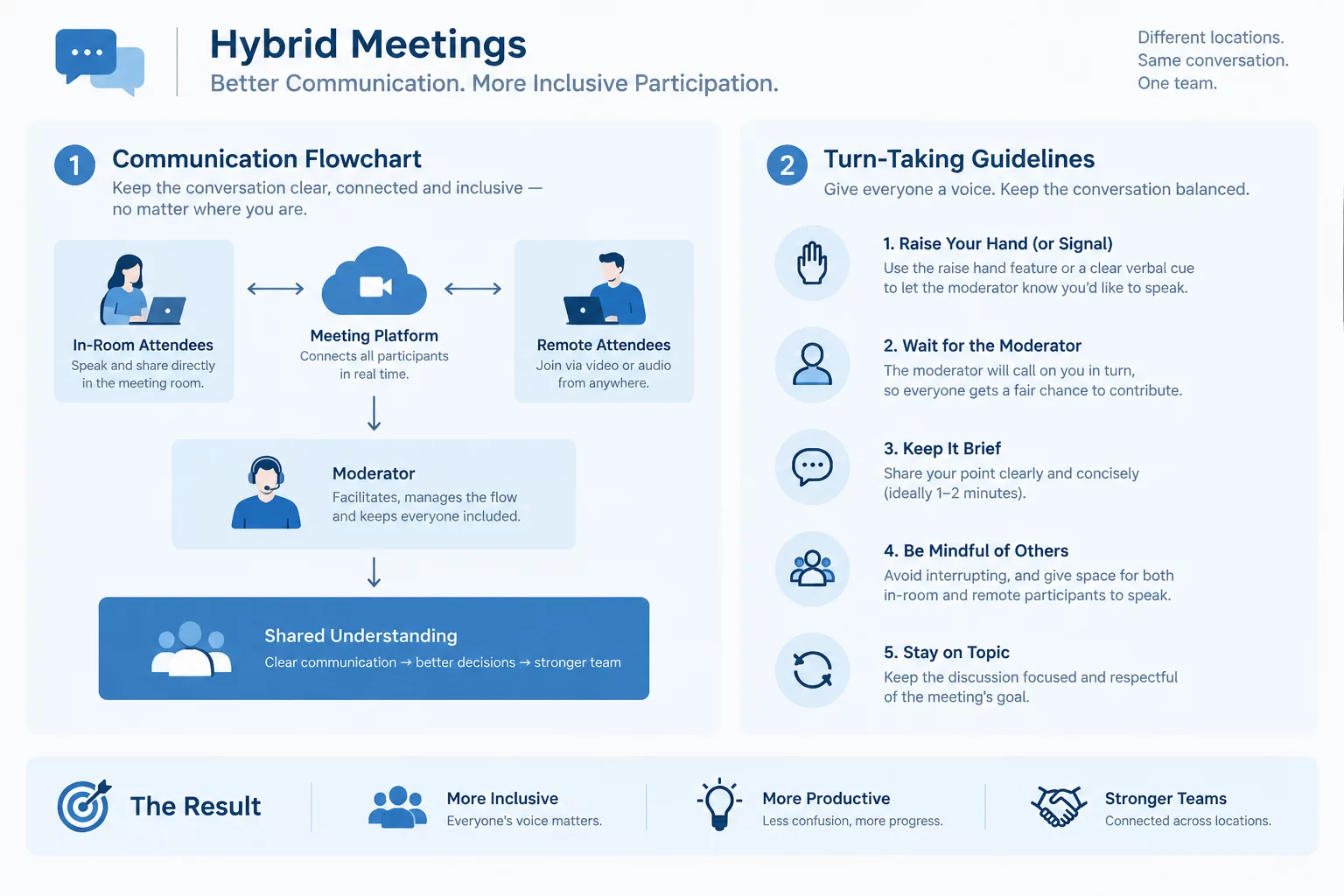
In a standard collocated meeting, natural physical cues guide conversation flow. In a fully virtual meeting, digital interfaces provide structured queue tools. Hybrid meetings, however, combine both environments, creating an asymmetrical dynamic where local room energy frequently overshadows remote participants. The moderator acts as the operational bridge, intentionally calibrating conversational airtime and audio balance so neither channel dominates the session.
Without deliberate facilitation, in-room discussions quickly devolve into rapid side conversations that microphones fail to isolate. Remote attendees become passive observers, missing non-verbal room agreements and hesitating to interrupt. The moderator counteracts this friction by establishing structured protocols before dialogue begins, managing agenda pacing, and serving as the direct advocate for remote contributors.
Four Primary Responsibilities of the Meeting Moderator
- Channel Equalization: Constantly monitoring digital hands and in-room gestures to sequence speaking turns in alternating order.
- Acoustic & Tech Vigilance: Verifying that screen shares remain legible, whiteboard drawings are digitized, and room audio stays crisp.
- Timeboxing & Pacing: Allocating dedicated speaking windows to prevent individual contributors from consuming disproportionate airtime.
- Decision Documentation: Logging consensus points live in the shared digital workspace to maintain a transparent single source of truth.
Mitigating In-Room Dominance and Presence Disparity
Presence disparity is the natural tendency for participants sharing physical space to build conversational momentum while overlooking screens. To counteract this, an experienced moderator adopts a 'remote-first' questioning technique. When transitioning to open discussion or feedback rounds, the moderator deliberately solicits input from virtual colleagues before inviting in-room commentary.
Furthermore, the moderator manages synchronous digital backchannels. Remote attendees frequently post clarifying questions or contextual links in chat while an in-room speaker is presenting. The moderator periodically pauses verbal discourse to read these chat contributions aloud, weaving virtual insights directly into the room's collective focus.
A hybrid meeting without an empowered moderator is simply two disjointed conversations pretending to be one.— Hybrid Collaboration Quarterly, Fall 2026
Practical Execution Framework for Hybrid Sessions
Structuring moderation requires measurable operational standards that both in-room and remote team members can anticipate. By codifying these behaviors into standard operating procedures, teams eliminate awkward talking-over instances and foster psychological safety across all locations.
Moderation Operational Standards & Expected Outcomes
| Dimension | In-Room Standard | Remote Standard | Expected Outcome |
|---|---|---|---|
| Turn-Taking Protocol | Physical hand raise recognized by moderator | Digital 'Raise Hand' queue indexed chronologically | 100% predictable turn sequence |
| Chat Integration | Displayed on secondary front-of-room monitor | Active text commentary & live emoji reactions | Zero overlooked text contributions |
| Synthesis & Wrap-up | Spoken confirmation of action owners | Live collaborative doc updated in real time | Immediate alignment on deliverables |
When organizations train moderators systematically, meeting velocity increases significantly while post-meeting misunderstandings diminish. Dedicated facilitation transforms hybrid collaboration from an exhausting logistical hurdle into an inclusive and decisive communication mechanism.